
The Hand That Will Testify
On the dust-covered hand of a woman killed by the machinery of Zionism and Western empire, who held nothing but a tasbeeh.

They would prefer you not to see this. They have built an entire vocabulary to make sure you don't. They will call it “collateral damage” and wrap it in the sterile language of military briefings, bury it beneath talk of “operational objectives” and “strategic necessity.” They will do everything in their power to make you forget that beneath the rubble of Gaza, there are hands, human hands, still reaching for the divine.
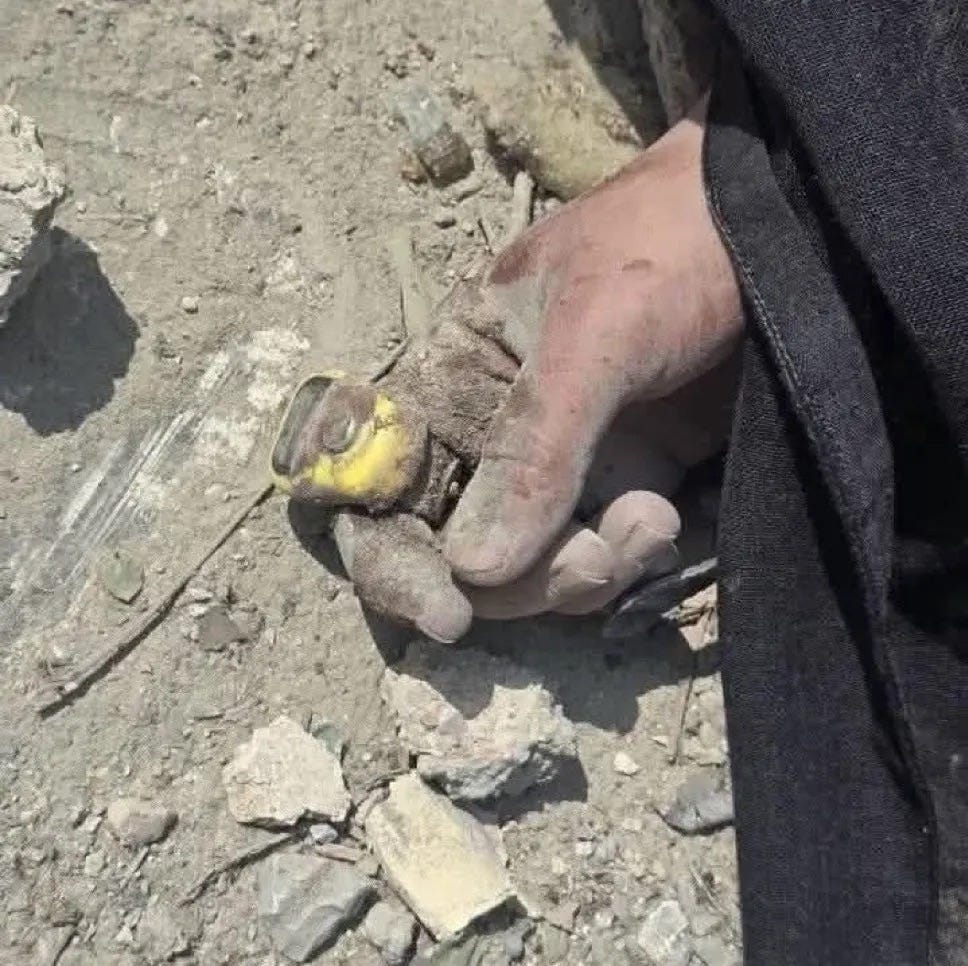
Look at this photograph. Look at it the way you would look at a mirror. A woman’s hand, gray with the dust of her own home, emerges from the wreckage. And between her fingers still warm with the rhythm of repetition and dhikr. You will see a tasbeeh. She was counting the names of God when they killed her.
Subhanallah. Subhanallah. Subhanallah.
How many times did she pass each bead between her thumb and finger before the missile found her? Was she on the thirty-third count? The sixty-sixth? Was she whispering Alhamdulillah at the exact moment that men in air-conditioned rooms decided her home was a legitimate target? There is an obscenity in this that no amount of analysis can ever describe.
I have been staring at this photograph for longer than I should admit. There is something about it that will not release me from its grasp. And it’s not just the rubble, or even the fact of death, which Gaza has made so relentlessly ordinary that we have begun to process it the way we process weather. What holds me is the tasbeeh, which tells you how she lived. The prayer beads, still looped around her finger, still resting in the curl of her hand as though she might, at any moment, resume counting. She was pulled from the world mid-sentence in a conversation with God, and the bead remains as proof that the conversation was, until the very last second, ongoing.
Alhamduillah. Alhamduillah. Alhamduillah.
Because there is a discipline to the tasbeeh that people outside our faith tradition rarely understand. It is not the absentminded rolling of beads between fingers while the mind wanders elsewhere. It is, when practiced with intention, among the most demanding acts of inner labor a human being can undertake. The deliberate, repetitive invocation of the divine name until the boundary between the one who remembers and the One remembered begins to thin. The great scholars of Islam wrote about this for centuries. They understood dhikr as the fundamental orientation of the soul. To remember God, they taught, is to wake up from the sleep that the world lulls you into, the sleep of accumulation and distraction and false safety, and to recognize that every breath you have ever taken was borrowed, and that the One who lent it to you is closer than the vein in your neck. That is what the beads are for. That is the work this woman was doing when Israel murdered her.
And I think this is where my grief becomes something harder and more dangerous than sadness. Because when I look at this photograph, I do not only see a woman martyred. I see a civilization that cannot recognize what it has killed. The Zionist project, from its very inception, has operated with the willful refusal to see the full humanity of the people it displaces. You cannot take someone’s home, demolish their village, uproot their orchards, cage them behind walls and checkpoints and then bomb them in the cage, unless you have first convinced yourself that they are somehow less. Less civilized, less rational, less human, less deserving of the category of grief. And so the Palestinian is reduced, always, to a political problem and almost never a person with a tasbeeh between their fingers and the names of God on their lips.
Allahu Akbar. Allahu Akbar. Allahu Akbar.
But here is what I find myself thinking, late at night, when the algorithm has served me another image from Gaza and I am trying to feel something that is not just helplessness. The tasbeeh is a refutation. And not necessarily a political refutation but something deeper. The entire machinery of occupation depends on the premise that power flows downward, that the one with the larger army and the more sophisticated weapons system determines reality. And the woman with the beads says, simply, no. There is a radical insistence that reality is not determined by whoever has the most F-35s. That there is an order beneath the disorder, a justice beneath the injustice, a Real beneath the real, and that the way you access it is not through domination but through submission. The submission of the one who has understood that the world and everything in it is passing, and that the only thing worth orienting your life around is the One who does not pass.
This is, incidentally, the thing that has always terrified empire, the person who cannot be bribed by its promises for wealth or broken by its threats and deceptions. Because they have located their center of gravity somewhere empire cannot reach. And this brings me to the thing I cannot stop thinking, the thing that makes this photograph not only evidence of Zionist war crimes but a kind of spiritual argument. There is a concept, and it runs through the Qur’an, that God is the best of planners. That what appears, from the limited vantage point of human history, to be the triumph of the oppressor is in fact a story that has not yet reached its final chapter. Pharaoh built monuments. Moses had a staff. Pharaoh is a cautionary tale and the staff parted a sea. The Qur’an returns to this pattern again and again, the powerful mistake their power for permanence, and this mistake is itself the seed of their unraveling. They build and build and build, and they believe that what they have built will outlast the people they have oppressed, and then, not always quickly, but with the inexorability of a tide the thing they built reveals itself to have been their demise all along.
I believe this as a description of how the world actually works. And I believe it not despite the photograph but because of it. Because the photograph contains, in a single frame, both the case for despair and the answer to it. The rubble is the case for despair. The tasbeeh is the answer. The rubble says look what they can do to you. But the tasbeeh says look what they cannot take from you.
They cannot reach her now. Whatever she was moving toward, bead by bead, breath by breath, in the quiet of her room before the ceiling came down, she was moving toward it with more certainty than the pilot who pressed the button that killed her has about anything in his life. I am convinced of this. The person who remembers God in a place like Gaza, under siege, under bombardment, possesses a kind of certainty that we living comfortably in the West cannot even imagine, let alone match.
What is happening in Gaza is the logical conclusion of a settler-colonial project that has spent three quarters of a century dehumanizing Palestinians in order to take what is theirs, and that is now, with the full backing of the most powerful empire the world has ever known, attempting to finish the job. The language of “two-sides” is a privilege of the unaffected. For the woman under the rubble, there was no “two-sides”. There was a roof, and then there wasn’t. There was life, and then there wasn’t. There was the tasbeeh, and this is the part that will not let me go, there still was.
La ilaha illAllah. La ilaha illAllah. La ilaha illAllah.
Whatever force collapsed the building around her was not enough to break the grip of her fingers around the tasbeeh. I do not know if this is physics or metaphysics. I do not know if her hand simply stiffened in death or if something else held it closed. But I know what it looks like. It looks like a woman who would not let go of God, even when everything else was taken from her.
And on Yawm Al Qiyyamah, I believe amongst the things shown will be a hand. Dust-covered, still, and ordinary. With a tasbeeh between its fingers. And the whole world will finally see what that hand was doing when they destroyed it. Remembering the name of the One in whose hands the final account rests.
That is the lesson this photograph teaches. It begins with a woman remembering God, and it ends with God remembering her.
إِنَّا لِلَّٰهِ وَإِنَّا إِلَيْهِ رَاجِعُونَ
Subhanallah, this is one of the most genuine and heartfelt pieces I've come across on Substack! Inna lilahi wa Inna ilayhi rajiun, may those within the Ummah who preserved the Deen until their very last breath be elevated to the highest ranks, especially under brutal, inhumane duress. Ameen.
I had to sit with this for a while… there’s something in that image that doesn’t just ask to be seen, it asks to be witnessed.
What stayed with me most wasn’t only the horror (though it’s there, unmistakably) but the quiet continuity of her remembrance. The beads still resting in her hand felt like a bridge between worlds… as if the conversation she was having with the Divine didn’t break, only changed rooms.
Across traditions, we return to this same simple act, don’t we? The turning of beads, the repetition of the Holy Names, the soft anchoring of the heart in something beyond the noise. Whether it’s called dhikr, japa, or something else entirely… it’s the same reaching. The same longing to stay connected, breath by breath.
And maybe that’s what makes this unbearable, and yet strangely luminous at the same time. Everything around her was reduced to rubble… but that thread of remembrance remained unbroken. As you said so powerfully: there is something they cannot take.
It makes me wonder… in our own quieter lives, with far less at stake, how often do we let go of that thread?
Thank you for writing this. It carries grief, yes—but also a kind of fierce, unshakeable dignity 🙏🏽☮️🙏🏽